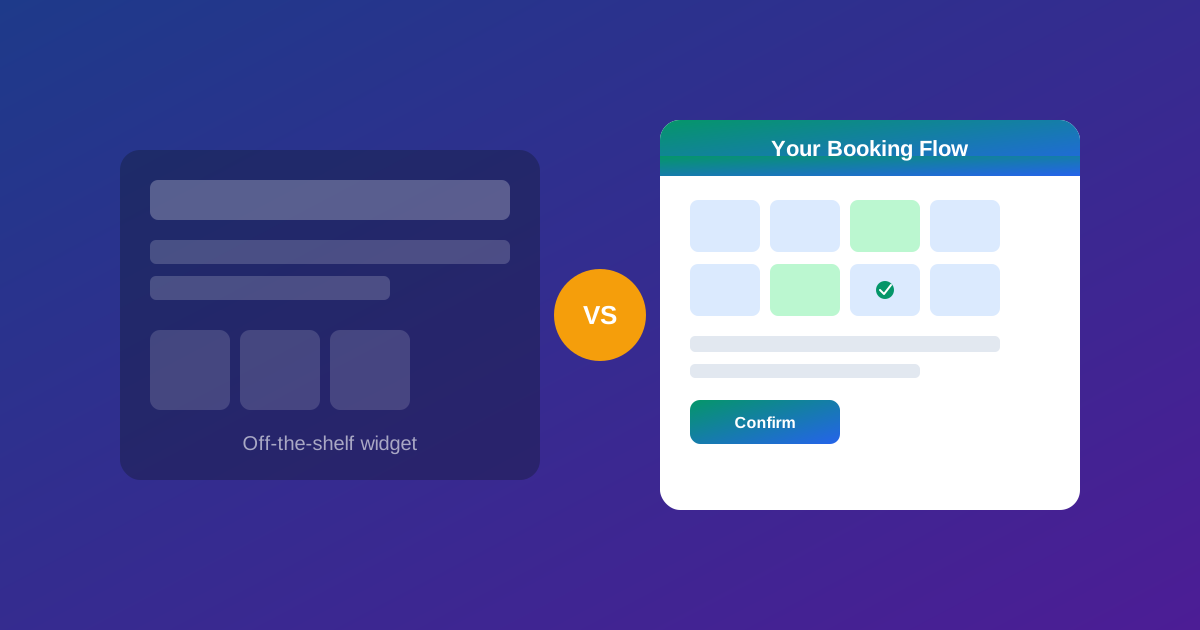
Most businesses that need booking or scheduling functionality reach for an off-the-shelf tool first, and for most of them, that's the right call. Calendly, Acuity, and similar tools handle simple appointment scheduling well, cost a fraction of custom development, and can be running the same day you sign up. The question worth asking isn't "custom or off-the-shelf" as a general preference — it's whether your specific booking logic actually fits what those tools are built for.
Booking platforms were part of the work I did at Taxon Technology, alongside analytics dashboards and business management tools, while leading the development team there. What follows is a practical way to tell which category your business falls into.
When an Off-the-Shelf Booking Tool Is the Right Answer
If your booking need looks like this, stop reading and go sign up for one:
- One person or a small number of interchangeable staff taking appointments
- Fixed appointment lengths with straightforward availability
- No dependency on inventory, resources, or another system needing to stay in sync with bookings
- Standard payment collection (or none) with no unusual rules
This covers a large share of small service businesses — consultants, single-location clinics, personal trainers, tutors. Paying a developer to build something custom here is money spent solving a problem that's already solved.
Where Off-the-Shelf Tools Start to Break Down
The pattern I've seen, both in the Taxon booking platform work and since, is that off-the-shelf booking tools handle the first resource or staff member fine and get progressively worse as complexity is added. Specific signs your business has outgrown the generic tool:
Multiple resources with independent, non-identical rules
One staff member works mornings only, another covers two locations, a third needs a longer buffer between bookings than everyone else. Generic tools usually assume interchangeable resources with the same rules — real businesses rarely work that way once they have more than a couple of people or assets to book.
Booking tied to something else that has to stay accurate
If a booking needs to check or update inventory, hold a resource that can't be double-booked in a physical sense (a room, a vehicle, equipment), or trigger a workflow in another system you run, that's an integration problem generic booking tools aren't built to solve well. This is usually the strongest signal that custom is worth the cost — the value isn't the calendar UI, it's the correctness of the data behind it.
The booking flow itself needs to match a specific process
Some businesses have a multi-step booking process — an intake form, a deposit, a confirmation step with specific conditions — that doesn't map onto a generic tool's fixed flow. Working around this with a generic tool usually means a worse experience for the customer, not a cheaper one.
What a Custom Booking System Actually Buys You
The real value isn't a nicer-looking calendar. It's availability logic that matches how your business actually operates, and a system that's connected to the rest of your platform instead of sitting next to it as a separate tool someone has to manually reconcile. On the Taxon booking platform work, that meant availability rules and business logic built around the actual operation, not fitted around a template's assumptions.
Automated reminders and confirmations matter here too — the same principle used on Rent Life's automated rent reminders applies directly: booking confirmations and reminders that run on schedule reduce no-shows without anyone tracking who's booked and needs a nudge.
How to Actually Decide
Write down your actual booking rules — every resource, every rule, every exception — before comparing anything. If that list fits comfortably into a form an off-the-shelf tool would let you configure, use the off-the-shelf tool. If you find yourself listing exceptions, workarounds, and "well, except when..." conditions, that's the signal custom development is worth pricing out.
If you want an honest read on which category your business falls into, describe your booking process and I'll tell you straight — including if the honest answer is "you don't need custom development for this."
Frequently Asked Questions
Is Calendly or Acuity ever the wrong choice?
For simple appointment scheduling, no — they're a good default. They become the wrong choice when your booking logic outgrows what they support: multiple resources with independent rules, booking tied to inventory, or a flow that needs to match your specific business process rather than a generic template.
How much more expensive is a custom booking system?
It costs more upfront than a monthly subscription to an off-the-shelf tool — there's no way around that. The comparison that matters is total cost: a subscription tool you're working around with manual workarounds and spreadsheets has ongoing costs too, just less visible ones.
Can a custom booking system still look and feel simple to customers?
Yes — custom doesn't mean complicated for the end user. If anything, a booking flow built around your specific process tends to feel simpler to customers than a generic tool asking questions that don't apply to your business.