On this page
- Understanding Multi-Tenancy: The Core Concept
- Multi-Tenancy Architecture Approaches in Laravel
- The Tenancy for Laravel Package: The Practical Choice
- Authentication in Multi-Tenant Laravel Applications
- Subscription Billing with Laravel Cashier
- Performance Optimisation for Multi-Tenant Applications
- Deploying Multi-Tenant Laravel Applications
- Building a Multi-Tenant SaaS With Expert Guidance
Multi-tenancy is the defining architectural challenge of SaaS development. Building a system where a single deployed application securely serves thousands of separate customers, with each customer's data isolated from all others, requires careful design decisions that influence every layer of the application. Get it right and you have a scalable SaaS business. Get it wrong and the technical debt accumulates into a system that becomes increasingly difficult to maintain, secure, and scale as your customer base grows.
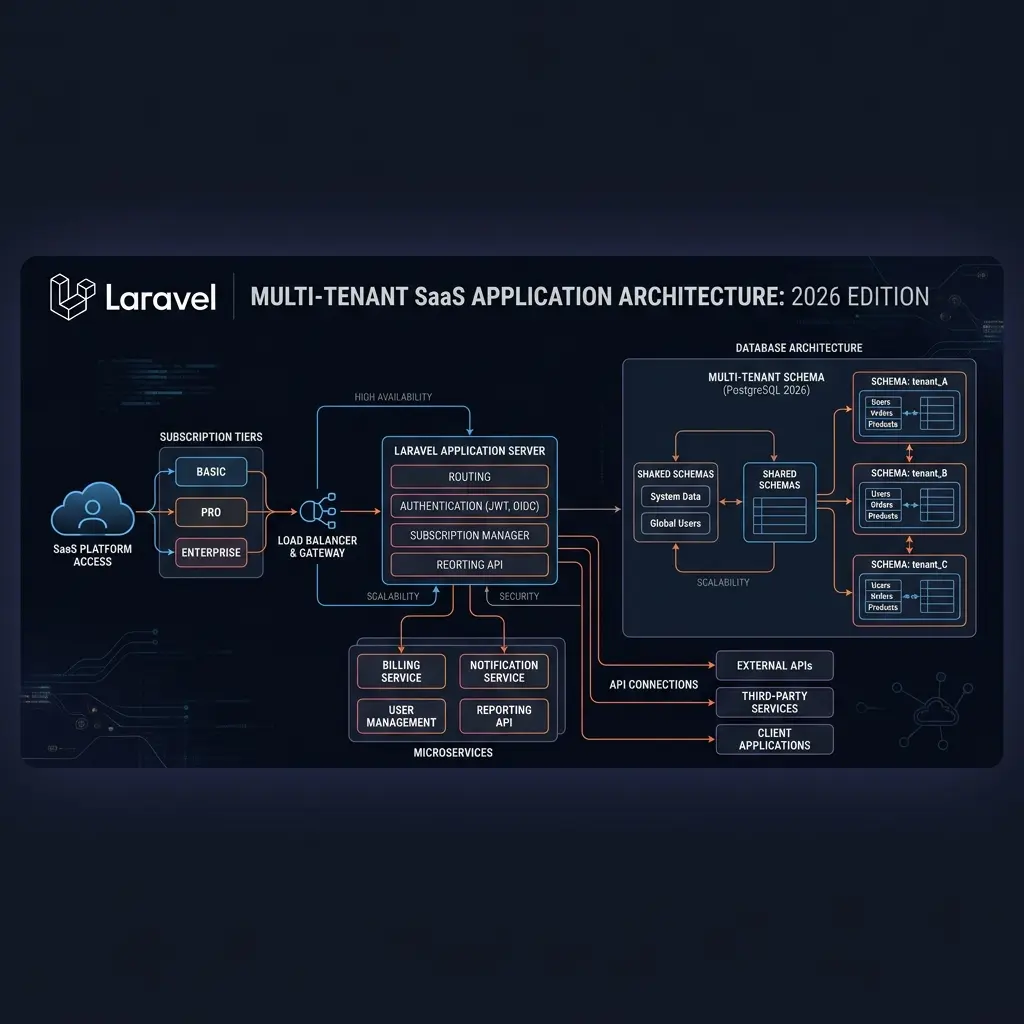
This guide covers the complete multi-tenant SaaS architecture journey in Laravel in 2026: choosing the right tenancy model, implementing it correctly, handling authentication and authorisation, integrating subscription billing, optimising performance at scale, and deploying to production. Whether you are starting a new SaaS product or planning to refactor an existing single-tenant application into a multi-tenant platform, this article walks you through the key decisions and implementation patterns.
Understanding Multi-Tenancy: The Core Concept
In a multi-tenant SaaS application, a single installed instance of the software serves multiple customers, called tenants. Each tenant believes they have their own dedicated system, because their data is isolated and their experience may be customised, but in reality they share the underlying application code and infrastructure with every other tenant.
This is in contrast to a single-tenant architecture, where each customer gets their own deployed installation of the application. Single-tenant deployment is simpler to implement but scales poorly, as managing hundreds of separate deployments becomes an operational nightmare, and the infrastructure cost of running a separate server for each customer makes the unit economics challenging for most SaaS business models.
The three primary multi-tenancy approaches each make different trade-offs between isolation, complexity, cost, and flexibility. Understanding these trade-offs is the first decision you need to make before writing any code.
Multi-Tenancy Architecture Approaches in Laravel
Approach 1: Single Database with Tenant ID Column
In this approach, a single database stores all tenant data. Every table that contains tenant-specific data has a tenant_id column. Every query that retrieves tenant data must include a WHERE tenant_id = ? condition. A global scope on all tenant-aware Eloquent models automatically applies this filter, so application code does not need to repeat the tenant filter on every query.
The advantage of this approach is operational simplicity. Running one database, applying one set of migrations, and managing one data store is significantly easier than managing hundreds of separate databases. This approach is well suited to SaaS applications in their early stages, where there are few tenants and operational overhead needs to be minimised.
The critical risk is that any bug that causes the tenant filter to be bypassed could expose one tenant's data to another. This is a security catastrophe for any SaaS product. Preventing it requires rigorous application of global scopes, careful testing of every data access path, and possibly database-level row security policies if you are using PostgreSQL.
Approach 2: Separate Database Per Tenant
Each tenant gets their own database. The application dynamically switches the database connection to the appropriate tenant database based on the identified tenant, typically from the subdomain or the authenticated user's tenant association. Each tenant database has the same schema, managed through the same migrations applied to each tenant database individually.
This approach provides the strongest data isolation. A tenant's data is genuinely separate from other tenants at the database level, making cross-tenant data leakage effectively impossible except through application-level bugs in the tenant identification logic itself. Per-tenant backup and restore is straightforward. Regulatory requirements that mandate data residency or strict separation are easier to satisfy.
The trade-offs are significant operational complexity and higher infrastructure cost. Running and maintaining separate databases for thousands of tenants requires automation of database creation, migration management across all tenant databases, and monitoring at a scale that single-database tenancy does not require. Cross-tenant analytics and reporting, such as aggregating metrics across all tenants for internal dashboards, become significantly more complex when the data is distributed across separate databases.
Approach 3: Schema-Based Multi-Tenancy (PostgreSQL)
PostgreSQL supports multiple schemas within a single database. In schema-based multi-tenancy, each tenant gets their own schema within a shared database. This sits between single-database and separate-database approaches in terms of isolation and complexity: the data is logically separated by schema while remaining within a single database instance, simplifying backup and certain administrative operations compared to fully separate databases.
Schema-based multi-tenancy is less commonly used with Laravel than the other two approaches because Laravel's database layer has historically been more oriented around MySQL, and schema management in PostgreSQL requires care to work correctly with Eloquent migrations. It is a valid approach for applications where PostgreSQL is preferred and the isolation guarantee of separate schemas is valuable.
The Tenancy for Laravel Package: The Practical Choice
Building multi-tenancy infrastructure from scratch is possible but time-consuming and error-prone. The Tenancy for Laravel package by Stancl (available at tenancyforlaravel.com) is the community's preferred solution for implementing multi-tenancy in Laravel applications. It supports both single-database and multi-database approaches, provides elegant APIs for tenant resolution and context switching, handles bootstrapping the correct database connection, cache prefix, and storage paths automatically when a tenant context is established.
Installation is via Composer: composer require stancl/tenancy. After publishing the configuration and running the provided migrations, you configure your tenancy bootstrappers, which are the components responsible for switching application state when a tenant context is initialised, and define your tenant identification strategy.
Tenant Identification Strategies
The most common identification strategy for SaaS applications is subdomain-based identification: each tenant has a unique subdomain, such as acmecorp.yoursaas.com, and the application reads the subdomain from the request to identify the tenant. Tenancy for Laravel provides subdomain tenant resolution that works with automatic subdomain routing configuration.
Domain-based identification allows tenants to use custom domains, such as app.acmecorp.com, pointing to your SaaS platform. This is more complex to implement because it requires wildcard DNS configuration and SSL certificate management for custom domains, typically using a service like Cloudflare for Saas or Let's Encrypt with automatic certificate provisioning. Tenancy for Laravel supports domain tenancy natively, and the infrastructure challenge of custom domain SSL can be addressed with Caddy server or Nginx with automatic certificate management.
Path-based identification is less common but sometimes used in applications where subdomain access is not practical. The tenant identifier is embedded in the URL path, such as yoursaas.com/t/acmecorp/dashboard. This approach is simpler to deploy but produces less professional-feeling URLs for customer-facing applications.
Authentication in Multi-Tenant Laravel Applications
User-Tenant Relationship Design
The relationship between users and tenants in a multi-tenant application can be modelled several ways. In the simplest model, each user belongs to exactly one tenant. Their tenant membership is determined by the tenant context in which they registered, and they can only ever access that tenant's data. This model covers many SaaS use cases and is straightforward to implement.
More complex applications allow users to belong to multiple tenants, with a user switching between tenant contexts after authentication. This is common in agency or consulting tools where a single user manages accounts for multiple clients. Implementing this correctly requires careful session management to track the current active tenant separately from the authenticated user identity.
Tenant-Aware Authentication Guards
Laravel's authentication system must be tenant-aware in a multi-tenant application. When a user authenticates, the authentication query must search for their credentials within the current tenant's data scope. In a single-database setup, this means the tenant ID filter must be applied to the user lookup query during authentication, not added after the fact. Tenancy for Laravel handles this for single-database setups automatically when models are correctly marked as tenant-aware. For separate-database setups, the database connection switches before authentication occurs, so queries naturally target the correct tenant database.
Super-Admin Access
Every multi-tenant SaaS application needs a mechanism for platform administrators to access any tenant's context for support, debugging, and administration purposes. Implementing this correctly requires a separate authentication path that can establish a tenant context without going through the normal tenant identification flow, combined with comprehensive audit logging of all administrative access to tenant contexts. This is a critical security feature: the ability to impersonate a tenant should be tightly controlled and always logged.
Building With Laravel?
Tell me about your Laravel project, new build, upgrade or rescue, and I'll reply within 24 hours.
Discuss Your ProjectSubscription Billing with Laravel Cashier
The subscription billing system is the revenue engine of your SaaS. Laravel Cashier provides fluent, tested Stripe integration that handles the complex billing scenarios every SaaS eventually needs.
Billing at the Tenant Level
In most multi-tenant SaaS applications, billing is associated with the tenant rather than with individual users. The tenant has a Stripe customer ID, a subscription, a payment method on file, and an invoice history. Individual users within the tenant can trigger actions (such as adding seats or upgrading plans) that affect the tenant's billing, but the billing relationship itself is with the tenant as a whole.
Implement the Billable trait on your Tenant model rather than your User model. This means your Cashier calls are made on tenant instances: $tenant->newSubscription('default', 'price_enterprise')->create($paymentMethodId). The Cashier migration creates the subscription tables in your central database (the database that stores tenant records and platform-level data), not in individual tenant databases.
Plan-Based Feature Flags
Multi-tenant SaaS products typically offer multiple subscription tiers with different capabilities. A common pattern for managing feature access by subscription tier is a feature flag service that checks the tenant's active subscription plan before allowing access to specific functionality. This can be implemented as a Laravel service class that maps subscription plan identifiers to feature sets, called before any action that requires a specific subscription tier.
Laravel Pennant, the official Laravel feature flag package released in Laravel 10, provides a structured way to define and check feature flags with tenant-aware context that integrates naturally with multi-tenant Laravel applications. Features can be defined with closures that check the tenant's subscription, their plan, or any other business logic that determines feature access.
Performance Optimisation for Multi-Tenant Applications
Tenant-Scoped Caching
All cached data in a multi-tenant application must be scoped to the specific tenant. A cache key written without a tenant prefix could be read by a different tenant's request, causing data leakage or incorrect cached results. Tenancy for Laravel automatically prefixes cache keys with the current tenant identifier when a tenant context is active, but you should verify this behaviour in your specific configuration and test it explicitly.
For frequently accessed, slow-to-compute data that is tenant-specific, such as complex permission structures, aggregated statistics, or configuration settings, cache aggressively with appropriate TTLs. The performance benefit of caching becomes more significant as tenant count grows, because the number of database queries that can be served from cache scales with the tenant count.
Database Query Optimisation at Tenant Scale
The most common performance problem in single-database multi-tenant applications is query performance degradation as data volume grows with tenant count. A table with no performance problems at one hundred tenants may become slow at ten thousand tenants simply because it contains one hundred times more rows. Index every tenant-specific table on tenant_id as the first column of a composite index. This ensures tenant-scoped queries can use the index efficiently rather than scanning the full table.
Monitor slow queries continuously in production using Laravel Telescope in non-production environments and database slow query logs in production. N+1 query patterns that are invisible in testing against small data sets become serious performance problems in production with large tenant counts. Review Eloquent relationship loading carefully and use eager loading for all relationships that are accessed in loops.
Queue Worker Isolation
Background jobs in a multi-tenant application must restore the correct tenant context before executing. When a job is dispatched from a tenant context, the tenant identifier must be serialised with the job so that the queue worker can re-establish the tenant context before the job runs. Tenancy for Laravel provides middleware for queued jobs that automatically handles this tenant context restoration.
Consider using separate queue workers for high-priority tenant operations versus bulk or reporting jobs. This prevents a long-running background job for one tenant from blocking time-sensitive operations for other tenants. Laravel Horizon provides the tooling to configure separate queue workers with different throughput characteristics and to monitor worker health and job throughput in real time.
Deploying Multi-Tenant Laravel Applications
Central and Tenant Database Migration Management
A multi-tenant Laravel application typically has two sets of migrations: central migrations that manage the platform-level database (containing tenant records, subscription data, and platform configuration), and tenant migrations that manage the schema applied to each tenant database in a multi-database setup. Running migrations on all tenant databases requires a custom artisan command or a deployment pipeline script that iterates through all tenants and applies pending migrations to each one.
This migration management complexity is one of the more significant operational challenges of multi-database tenancy. Tenancy for Laravel provides tooling to run tenant migrations, but you need to integrate this into your deployment pipeline and test migration rollouts carefully to ensure they complete reliably across potentially thousands of tenant databases.
Infrastructure for Production Scale
A production multi-tenant Laravel SaaS requires infrastructure designed for the expected scale from the beginning. A single-server deployment is appropriate for early validating a market with a small number of tenants, but growing beyond a few hundred active tenants typically requires a load-balanced application tier with shared session and cache state in Redis, a managed database service with read replicas for reporting workloads, and a CDN for static assets and potentially for caching public pages.
Managed database services from AWS RDS, Google Cloud SQL, or DigitalOcean Managed Databases provide the reliability, automated backups, and scaling capabilities that production SaaS applications require. The operational cost of managing database infrastructure yourself, including backup management, failover, and performance tuning, is rarely justified compared to managed service costs for most SaaS businesses.
Building a Multi-Tenant SaaS With Expert Guidance
Multi-tenant SaaS development in Laravel requires a combination of deep framework knowledge, architectural experience, and careful attention to security and performance implications that are not obvious until they become production problems. The decisions made early in a SaaS product's architecture are the hardest to change and have the most significant long-term impact on the business's ability to grow and compete.
I specialise in building multi-tenant SaaS applications with Laravel for businesses across the UK, US, Canada, and globally. I have architected and built SaaS platforms from MVP to enterprise scale, including multi-database tenancy implementations with thousands of tenant databases, subscription billing with complex plan logic and usage-based pricing, and high-performance queue architectures processing millions of jobs per day.
Get in touch to discuss your SaaS project. Whether you are starting a new SaaS product and need architectural guidance from day one, or you are scaling an existing product and facing the performance and complexity challenges that come with growth, I can help you build the right foundation.