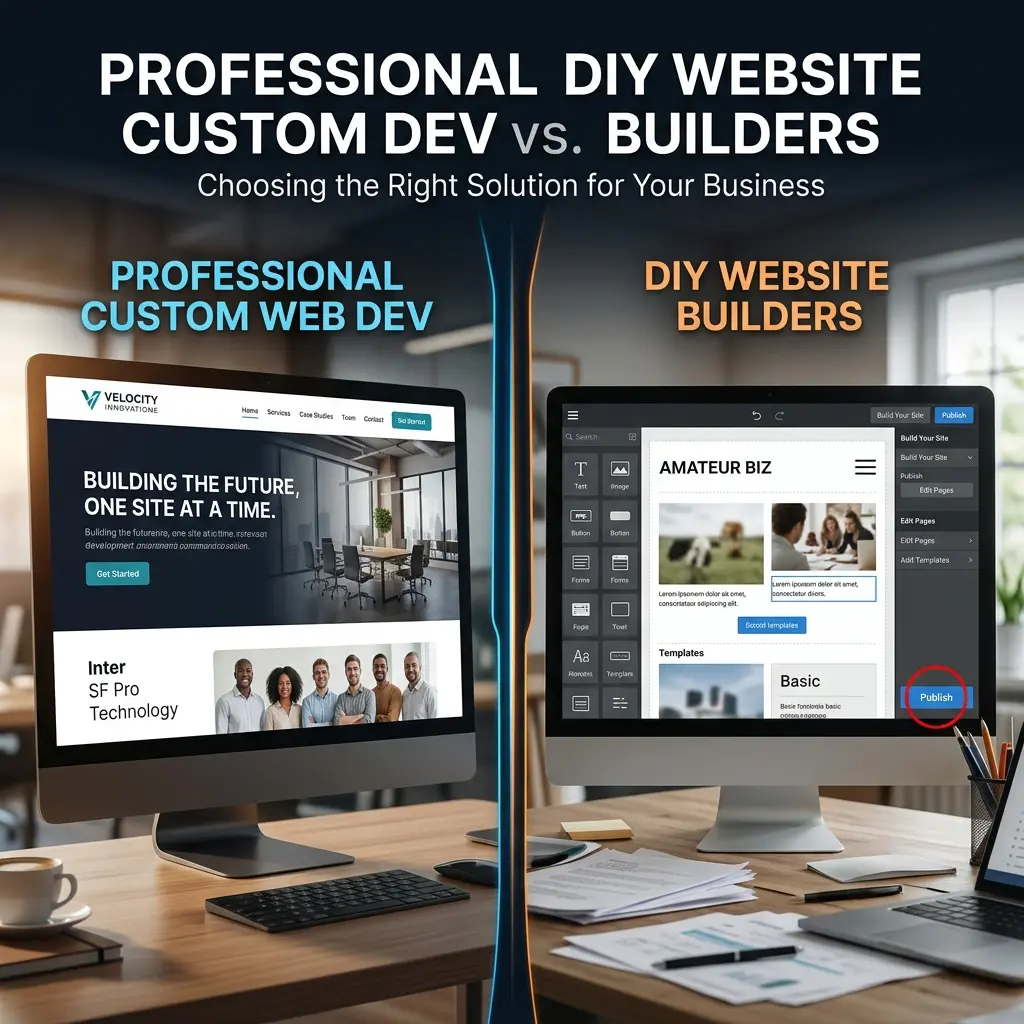
Every business owner who needs a website faces the same tempting offer: build it yourself in an afternoon using Wix, Squarespace, or a similar drag-and-drop builder, invest a few hours of your own time, and spend less than $300 per year. Compare that to hiring a professional custom web developer for a project that costs several thousand dollars and takes weeks to complete. On the surface, the DIY option seems like an obvious win.
The problem is that this comparison is fundamentally misleading. It compares upfront cost and time-to-launch without accounting for what happens after launch — the performance gap, the SEO handicap, the conversion rate difference, the security vulnerabilities, the scalability limits, and the opportunity cost of running a website that is holding your business back. When you factor in what your website is actually doing, or failing to do, for your business over three to five years, professional custom web development almost always delivers dramatically better return on investment than DIY tools.
This guide examines every dimension of the professional custom web development versus DIY website builder comparison, with specific, measurable differences rather than vague claims, so you can make an informed decision about the right choice for your business.
Understanding What DIY Website Builders Actually Are
To compare fairly, it is important to understand what DIY website builders like Wix, Squarespace, Weebly, GoDaddy Website Builder, and similar tools are designed to do. These platforms are designed for speed and accessibility, not for optimisation or advanced capability. They target non-technical users who need a basic online presence quickly and cheaply and are willing to accept the significant limitations that come with the platform in exchange for not needing technical knowledge.
DIY website builders generate your website's code automatically based on template selections and drag-and-drop content arrangement. This generated code is inherently less efficient than handcrafted code because it must be generic enough to support any combination of template options any user might choose. The code that renders your five-page business website carries all the CSS, JavaScript, and HTML infrastructure needed to render any possible template configuration — even the ones you are not using.
Professional custom web development, by contrast, builds precisely and only what your specific website needs. Every line of code serves your website's particular design, content, and functionality requirements. Nothing is generated generically or included as unused infrastructure.
Performance: The Measurable Difference That Affects Every Visitor
Website performance is where the professional custom web development versus DIY comparison produces the most stark, measurable differences. Multiple studies have established that website load time directly determines whether visitors stay and convert, and the advantage of professionally built custom websites over DIY platforms is substantial and consistent.
Testing a typical Wix business website against Google Lighthouse produces mobile performance scores consistently in the 30 to 55 range. Squarespace sites score somewhat better, typically 45 to 65, but still perform significantly below optimal. The reasons are structural: Wix loads its entire editor infrastructure even for visitors, generates deeply nested HTML that browsers must parse extensively, and triggers multiple render-blocking JavaScript files before any content appears. Squarespace loads heavy JavaScript bundles for template features you may not use and handles image loading less efficiently than modern custom implementations.
A professionally built custom website, optimised specifically for your content and design, regularly achieves mobile performance scores of 85 to 98. The gap is not marginal — it represents the difference between a website that loads in under one second and one that takes three to five seconds on mobile connections. Given that 53% of mobile visitors abandon pages that take longer than three seconds to load, this performance difference translates directly to dramatically different visitor retention rates and conversion opportunities.
If your website receives 5,000 monthly visitors on mobile, and half abandon a DIY site before it loads but only 10% abandon a fast custom site, that is 2,000 additional potential customers per month who actually see your content and have the opportunity to contact you. Over a year, that is 24,000 additional visitors reached — a number that dwarfs the professional web development investment cost multiple times over.
SEO: Why Custom Development Creates Search Engine Advantages
Search engine optimisation determines how many people discover your website through Google and other search engines. DIY website builders create several structural disadvantages that limit search engine visibility compared to professionally built custom websites.
Core Web Vitals and Google Rankings
Google's Core Web Vitals are a set of performance metrics that Google uses as search ranking signals. They measure Largest Contentful Paint, how quickly the main content loads, Interaction to Next Paint, how quickly the page responds to user interactions, and Cumulative Layout Shift, whether content jumps around as the page loads. Google has clearly stated that websites that pass Core Web Vitals thresholds receive a ranking boost over those that fail.
DIY platforms consistently produce poor Core Web Vitals scores due to their generated code architecture. Wix is particularly problematic, with many sites failing LCP thresholds due to late-loading hero images and render-blocking resources. Squarespace sites often fail INP due to heavy JavaScript execution. Professional custom web development targets Core Web Vitals as explicit success criteria, ensuring your website receives the Google ranking benefit rather than the penalty.
Technical SEO Foundation
Beyond Core Web Vitals, professional custom web development enables technical SEO implementation that DIY platforms handle inconsistently or inadequately. Custom development ensures proper semantic HTML5 structure with appropriate use of header, main, article, section, and nav elements that communicate page structure to search engines. It enables Schema.org structured data markup precisely tailored to your business type, enabling rich search results including star ratings, FAQ accordions, event listings, and other enhanced SERP features.
Professional custom web development also provides full control over URL structure, canonical tags, hreflang for multilingual sites, XML sitemap configuration, robots.txt, and meta tag implementation — all of which Wix and Squarespace handle in constrained, sometimes incorrect ways that create crawl budget waste and indexation problems for growing sites.
Conversion Rate: Turning Visitors Into Enquiries and Customers
Conversion rate is the percentage of visitors who take the action you want — submitting a contact form, calling your phone number, making a purchase, booking an appointment, or signing up for your service. The difference in conversion rates between a professionally designed custom website and a DIY website template can be the most significant financial difference in the comparison.
Professional custom web development includes conversion rate optimisation as a core design discipline. UX research and user journey mapping inform the placement of calls to action. Above-the-fold content is designed to communicate your value proposition immediately, reducing bounce rates. Form design is optimised to minimise friction, with the right number of fields for the conversion action required. Trust signals including testimonials, case studies, security badges, and professional photography are placed strategically in the conversion funnel.
DIY website builder templates are designed to accommodate any kind of business and any kind of content, which means they are optimised for none of them. Call to action placement, form length, and trust signal positioning follow generic template defaults rather than research specific to your business, audience, and conversion goal. A professional custom website for your specific service business is designed based on what makes people in your market take action, not based on what works generically across all possible businesses.
Security: A Structural DIY Disadvantage
Security is an area where DIY platforms have a mixed track record that is often not discussed in builder marketing materials. Wix and Squarespace handle their own security patching, which protects from platform-level vulnerabilities, but both platforms have had security incidents and their closed nature means independent security research and rapid community-driven patching is not possible.
DIY tools that run on open source platforms — particularly WordPress with third-party themes and plugins — carry significant security risks from the plugin ecosystem. Small business owners using WordPress page builders like Elementor, contact form plugins like Contact Form 7, and e-commerce plugins like WooCommerce are exposed to the security vulnerabilities of each of these codebases. Critical vulnerabilities are discovered regularly, and sites that are not updated within hours of a vulnerability disclosure are automatically targeted by bots scanning for vulnerable plugin versions.
Professional custom web development builds the minimal codebase required for your specific website, with no third-party plugin ecosystem introducing uncontrolled security risks. Security controls are implemented deliberately: input validation, output encoding, CSRF protection, secure session management, and proper authentication are built in from the start. The attack surface is dramatically smaller because the codebase itself is smaller and more focused.
Scalability and Custom Functionality: Where DIY Can't Follow
As your business grows, your website requirements evolve. You may need customer portal functionality, online appointment booking with calendar integration, custom product configurators, membership areas with access control, integration with your CRM or ERP system, multi-location management, multi-currency support, or complex custom business logic that no template can accommodate. DIY platforms categorically cannot support these requirements.
Every significant custom functionality requirement on a DIY platform forces one of three unsatisfying resolutions: find a plugin or app that approximately meets the need and accept its limitations, use integration platforms like Zapier to bolt together multiple tools at significant cost and reliability risk, or abandon the requirement and constrain how your business can operate online. Each of these is a symptom of choosing a platform that cannot grow with your business.
Professional custom web development has no functionality ceiling relevant to your business needs. Any functionality that is technically achievable can be built. Your CRM integration works exactly as your business operations require. Your booking system enforces your specific availability rules. Your customer portal shows exactly the information your customers need. The website serves your business operations rather than your business operations adapting to the website's limitations.
The True Cost Comparison Over Three Years
A genuine total cost of ownership comparison between DIY and professional custom web development over three years typically looks very different from the upfront cost comparison.
A Squarespace Business plan costs approximately $276 per year. Premium add-ons, custom domain, email hosting, and scheduling tools might add another $200 per year. E-commerce transaction fees on the Business plan are 0%, but specific features require the Commerce plan at $396 per year. Over three years, total platform costs: approximately $1,500 to $2,000.
But add the hidden costs: the 40 to 60 hours of your own time building and maintaining the site at your professional hourly value, the cost of a freelance developer for customisations that exceeded your DIY capabilities, the revenue lost from visitors who abandoned due to slow loading or poor conversion design, and the marketing budget wasted driving traffic to a site that under-converts. The true three-year cost is often $8,000 to $20,000 when your time and opportunity costs are included.
A professionally built custom website costs $5,000 to $15,000 upfront and $150 to $500 per month for hosting and maintenance. Over three years: $10,400 to $33,000 inclusive of all costs. At the upper end, this is more expensive than DIY. But the professionally built website converts at two to three times the rate, ranks better in search engines generating more organic traffic, loads faster retaining more visitors, and can accommodate custom functionality that drives additional revenue streams. When the revenue difference is factored in, professional custom web development almost always delivers superior ROI.
Making the Right Decision for Your Business
DIY website builders serve a legitimate purpose for pre-revenue businesses testing a concept, sole traders who need a minimal online presence with minimal budget, and personal projects. For these use cases, the limitations are acceptable because the stakes are low.
Professional custom web development is the right investment when your website is a serious business asset, when you depend on it for lead generation and revenue, when your brand positioning requires a distinctive and credible appearance, when you need custom functionality that templates cannot provide, or when your competitors have strong web presences and you need to match or exceed them.
If you are ready to move beyond the limitations of DIY website builders and invest in a professional custom web development project, I build custom websites and web applications for businesses across the US, UK, Canada, Germany, and globally. My approach focuses on measurable business outcomes — performance, SEO, conversion rate, and lead generation — rather than just aesthetics.
Contact me today and let me show you what a professionally built custom website can do for your business that a DIY builder simply cannot achieve.