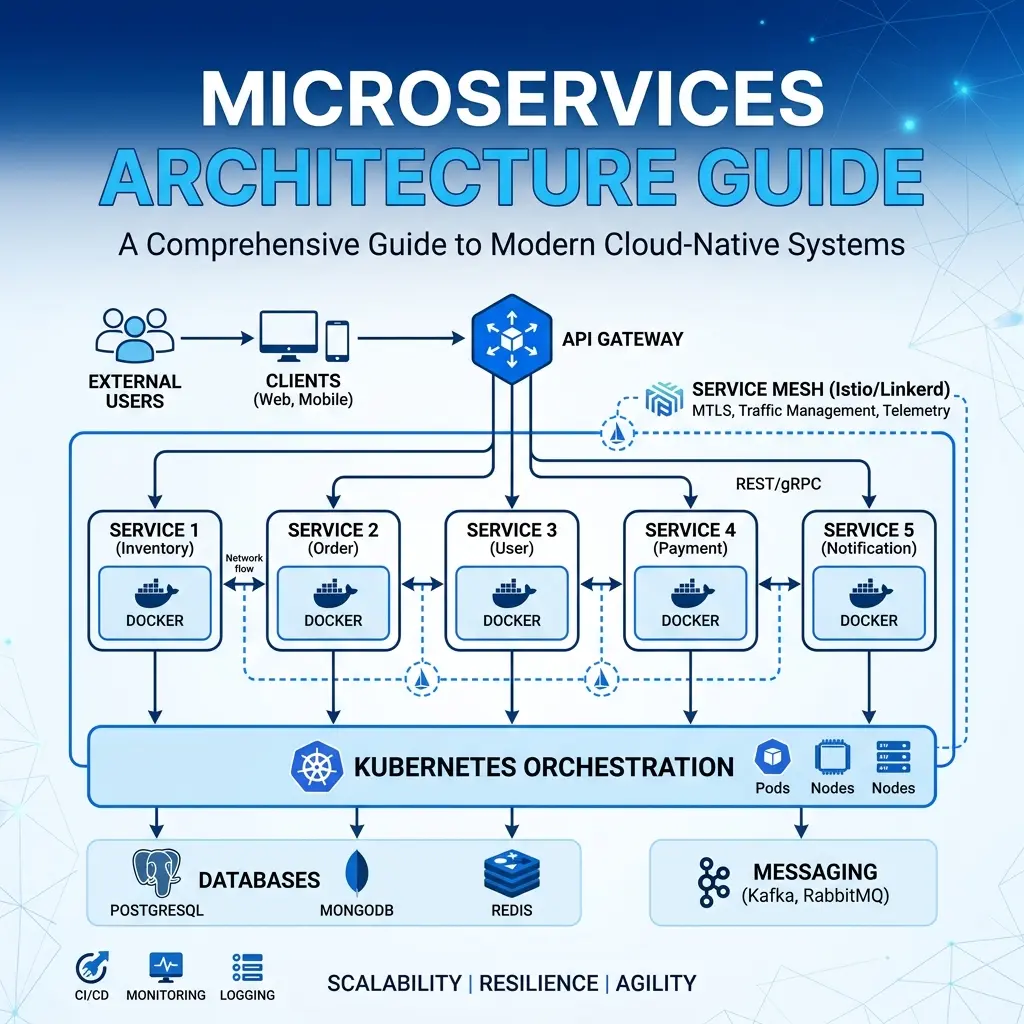
Microservices architecture has transformed how modern businesses build and scale software systems. By decomposing applications into small, independently deployable services each responsible for a specific business capability, microservices architecture enables the organisational and technical agility that large-scale digital businesses require. Companies like Netflix, Amazon, Uber, and Spotify built their global platforms on microservices architectures, and the approach has filtered down to mid-market and even some small business software systems.
But microservices architecture is not a universal solution, and misapplying it is expensive. The complexity microservices introduce — distributed systems challenges, network latency between services, complex deployment infrastructure, distributed tracing needs, and organisational coordination requirements — is real and significant. Understanding when microservices architecture is the right choice, how to design microservices systems correctly, and how to operate them reliably in production is what separates teams that succeed with microservices from those who struggle and sometimes retreat to simpler architectures.
This ultimate guide to microservices architecture covers every aspect of the approach, from foundational concepts and design principles through implementation patterns, tooling, and operational best practices.
What Is Microservices Architecture? Foundational Concepts
Microservices architecture is an approach to building applications as a collection of small, loosely coupled, independently deployable services, each running in its own process and communicating with each other through well-defined APIs, typically HTTP or asynchronous messaging. Each microservice is responsible for a specific, bounded business capability and owns its own data store, making it independently deployable and independently scalable.
This is in contrast to monolithic architecture, where all application functionality is deployed as a single unit. A monolithic application might have separate modules for user management, product catalog, orders, payments, and notifications, but all of these modules run as a single process and share a single database. Monolithic applications are simpler to develop, test, and deploy in early stages, but as they grow larger and teams multiply, they become difficult to change and scale.
The defining characteristics of microservices architecture are small service size aligned to a single business capability, independent deployability meaning any service can be updated and deployed without redeploying other services, decentralised data management where each service owns its own data store rather than sharing a central database, and technology heterogeneity allowing different services to use the most appropriate technology for their specific needs.
Monolith vs Microservices: Making the Right Architecture Decision
Before designing a microservices architecture, you must honestly assess whether microservices is the right choice for your specific situation. The incorrect choice in either direction has substantial costs.
When Monolithic Architecture Is the Right Choice
For most new products, teams, and organisations, starting with a well-structured monolithic application is the correct architectural decision. A monolith is simpler to develop, faster to iterate on, easier to test end-to-end, cheaper to deploy and operate, and much easier to refactor when your understanding of the domain evolves.
Choose a monolithic architecture when your team is small and would be overwhelmed by microservices operational complexity, when your domain is not yet well understood and boundaries are likely to change, when your product is in early stages and speed of iteration is the top priority, when you do not have production experience operating distributed systems, or when your scale requirements do not justify the overhead of service decomposition.
When Microservices Architecture Is the Right Choice
Microservices architecture delivers its benefits at specific scales of team size, system complexity, and deployment frequency that most systems never reach. Choose microservices architecture when different parts of your system have fundamentally different scaling requirements and scaling them independently would deliver meaningful cost savings, when you have multiple independent teams that experience coordination overhead when deploying the monolith, when different services genuinely benefit from different technologies, when regulatory or security requirements mandate isolation of certain capabilities, or when you have experienced production engineers who can manage distributed systems complexity.
The most successful pattern for organisations moving to microservices is the strangler fig pattern: starting with a monolith, identifying the first service to extract based on clear business boundary and independent scaling need, extracting that service while the monolith continues to handle everything else, and gradually extracting additional services as the need becomes clear. This evolutionary approach avoids the costly mistake of decomposing a system into microservices before the domain is well understood.
Microservices Design Principles: Building the Right Boundaries
The most consequential decisions in microservices architecture are the service boundaries — which capabilities belong in which service, and how services should be divided. Incorrect service boundaries create distributed monoliths that have all the operational complexity of microservices with none of the agility benefits, because every change requires coordinating updates across multiple services simultaneously.
Domain-Driven Design and Bounded Contexts
Domain-Driven Design, or DDD, provides the theoretical foundation for designing good microservices boundaries. The key DDD concept for microservices is the Bounded Context: a defined scope within which a particular model is consistent and applicable. Each microservice should correspond to one Bounded Context, implementing the domain model for that context and owning all data and logic within it.
Identify Bounded Contexts by mapping the business domain, looking for where different teams use the same words but mean different things, where data has fundamentally different structures depending on the business function using it, where there are natural separation points in business processes, and where the pace of change differs significantly between different capabilities.
Single Responsibility and Service Cohesion
Each microservice should have high cohesion — all functionality within the service is closely related and serves a single business capability — and low coupling — the service has minimal dependencies on the internal implementation details of other services. If you find yourself frequently changing two services together when a business requirement changes, those services are likely incorrectly separated and should be merged or their boundaries redrawn.
Service Communication Patterns in Microservices Architecture
The way microservices communicate with each other is perhaps the most technically complex aspect of microservices architecture. Two fundamentally different communication patterns serve different use cases with different reliability and consistency characteristics.
Synchronous Communication: REST and gRPC
Synchronous HTTP REST communication between microservices is familiar, simple to implement, and appropriate for request-response interactions where the calling service needs the result before it can continue processing. REST is the most common synchronous communication pattern due to its universality, tooling support, and ease of debugging.
gRPC provides a high-performance alternative to REST for internal service communication in microservices architectures. gRPC uses HTTP/2 for efficient binary framing, Protocol Buffers for compact serialisation that is far smaller than JSON, and strong typing through the Protocol Buffer schema. For services that communicate frequently with large volumes of data, gRPC's performance advantages can be significant. Netflix, Square, and CoreOS use gRPC for internal microservices communication.
The risk of synchronous communication in microservices architecture is cascading failure. If Service A calls Service B, which calls Service C, and Service C is slow or unavailable, the failure propagates back through the chain. Implement Circuit Breaker patterns using libraries like Hystrix, Resilience4j, or the built-in circuit breaker in Istio service mesh to prevent cascading failures by failing fast when a dependency is unhealthy.
Asynchronous Communication: Event-Driven Microservices
Asynchronous event-driven communication through message brokers like Apache Kafka, RabbitMQ, or AWS SQS decouples microservices in time as well as in implementation. Rather than calling another service directly, a microservice publishes an event to a topic, and any interested services subscribe to that topic and process events independently.
Event-driven microservices architecture provides superior resilience because services do not fail when their dependencies are temporarily unavailable — messages accumulate in the broker and are processed when service capacity returns. It also enables very high throughput because services process messages at their own pace rather than being blocked waiting for synchronous responses.
Apache Kafka is the leading event streaming platform for high-throughput, high-reliability event-driven microservices architectures. Kafka's distributed log architecture provides durable message storage, configurable retention, consumer group scaling, exactly-once semantics, and replay capability that RabbitMQ cannot match at scale. For lower-volume event-driven communication, RabbitMQ's simpler operational model and flexible routing capabilities make it an appropriate choice.
The Saga Pattern: Managing Distributed Transactions
One of the most challenging problems in microservices architecture is managing data consistency across service boundaries. In a monolith with a shared database, you can use database transactions to atomically update multiple tables — either all changes succeed or none do. In microservices architecture, where each service owns its own database, you cannot use standard database transactions across services.
The Saga pattern is the established solution for distributed transactions in microservices architecture. A saga is a sequence of local transactions where each service performs its local transaction and publishes an event. The next service in the saga picks up the event and performs its local transaction. If any step fails, the saga executes compensating transactions in reverse order to undo the changes already made by previous steps.
The choreography approach to implementing sagas has services react to events and publish new events in a fully decentralised manner. The orchestration approach uses a central saga orchestrator that directs each participating service and manages compensating transactions on failure. Orchestration is generally easier to monitor and debug than choreography, particularly for complex multi-step sagas.
Containerisation and Orchestration: Docker and Kubernetes
Microservices architecture and containerisation technology are deeply interdependent. Running dozens of independent services as separate processes on physical or virtual servers is operationally prohibitive. Docker containers package each microservice with its dependencies into a portable, consistent unit that runs identically in development, testing staging, and production environments.
Kubernetes is the industry-standard container orchestration platform for managing microservices deployments at scale. Kubernetes handles scheduling containers across a cluster of servers, restarting failed containers automatically, scaling service instances up and down based on CPU and memory metrics, routing traffic to healthy instances, managing secrets and configuration, rolling out new versions without downtime, and rolling back failed deployments.
For teams new to Kubernetes, managed Kubernetes services from cloud providers including Amazon EKS, Google GKE, and Azure AKS significantly reduce the operational burden by managing the control plane. The team focuses on defining Kubernetes manifests for their microservices, and the cloud provider manages the Kubernetes infrastructure itself.
Observability: Monitoring Microservices in Production
Observability is far more challenging in microservices architecture than in monolithic systems. When a request that traverses six services fails, identifying which service caused the failure, why it failed, and what the complete execution path looked like requires three pillars of observability working together: metrics, logs, and distributed tracing.
Distributed tracing is the capability that is uniquely critical to microservices architecture. A trace follows a single request as it propagates across multiple services, recording timing and context at each hop. Implement distributed tracing using OpenTelemetry, the vendor-neutral standard for generating and collecting telemetry data, and send traces to a backend like Jaeger, Zipkin, or a commercial observability platform like Datadog or Honeycomb.
A service mesh like Istio or Linkerd adds a sidecar proxy to every service container that handles service-to-service communication, automatically providing mutual TLS encryption, traffic metrics, circuit breaking, and distributed tracing without requiring any changes to service code. For large microservices deployments, a service mesh provides an invaluable operational layer that simplifies many cross-cutting concerns.
If you are evaluating whether a microservices architecture is right for your business or need help designing and implementing microservices systems, I specialise in microservices architecture and distributed systems development for businesses across the US, UK, Canada, Germany, and globally. I help businesses make the right architectural choices and implement them correctly, avoiding the complexity traps that make microservices migrations fail.
Contact me today to discuss your architecture requirements and build the right foundation for your business's scale and growth ambitions.