On this page
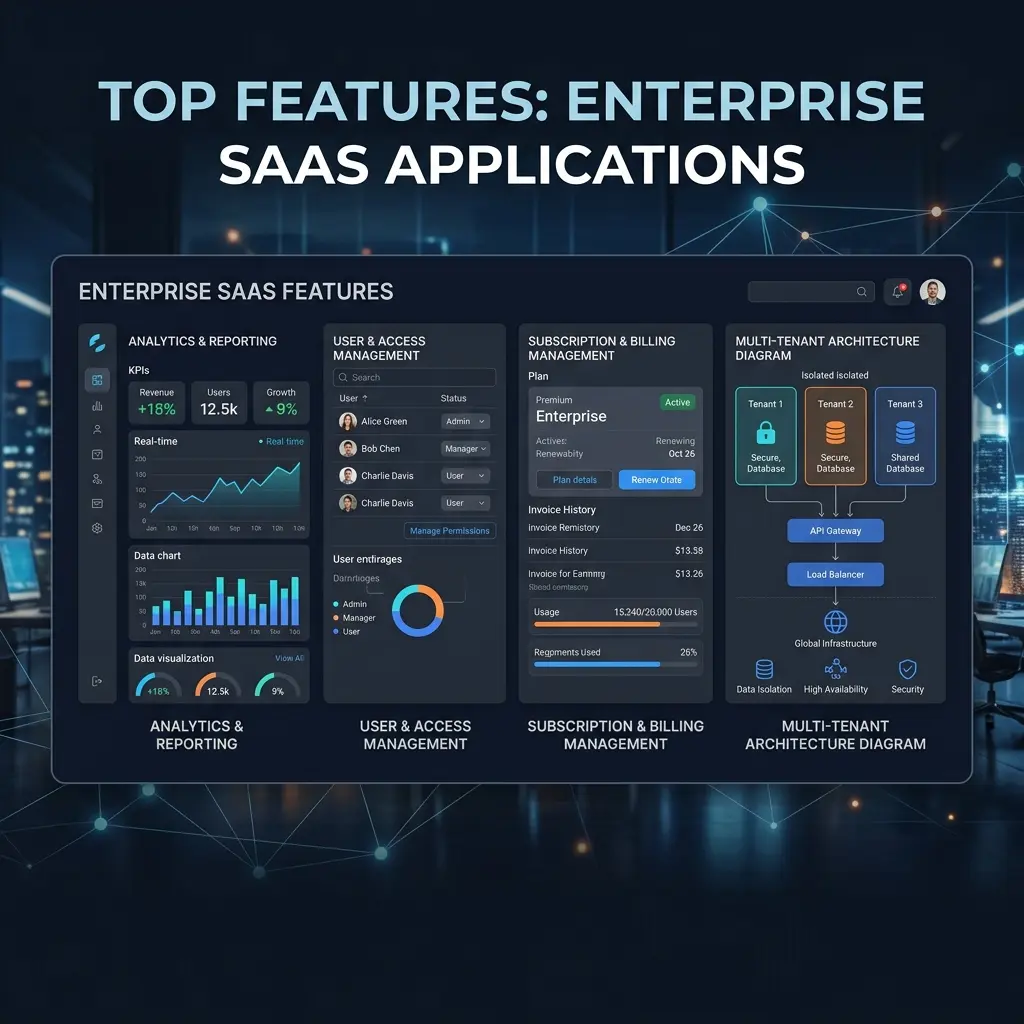
- Feature 1: Multi-Tenant Architecture with Strict Data Isolation
- Feature 2: Single Sign-On Integration
- Feature 3: Role-Based Access Control with Granular Permissions
- Feature 4: Advanced Audit Logging and Compliance Reporting
- Feature 5: API-First Architecture with Comprehensive Developer Tools
- Feature 6: Enterprise-Grade Security Certifications
- Feature 7: Advanced Analytics and Customisable Reporting
- Feature 8: High Availability and Disaster Recovery
- Feature 9: Custom Branding and White-Labelling Capabilities
- Feature 10: Flexible Subscription Management and Enterprise Billing
Building a SaaS product that enterprise organisations will buy, deploy at scale, and depend on long-term is fundamentally different from building a SaaS product for small businesses or individual users. Enterprise customers have requirements that are non-negotiable and that many SaaS products fail to meet, resulting in failed sales cycles and churned accounts even when the core product functionality is strong.
Enterprise SaaS features are not simply more of what SMB SaaS provides. They represent qualitatively different capabilities around security, compliance, administration, integration, and reliability that enterprise procurement teams evaluate rigorously before making purchasing decisions. Understanding and building these enterprise SaaS features from the ground up determines whether your SaaS product can access the highest-value customer segment or must remain limited to the mid-market.
This guide covers the ten most critical enterprise SaaS features that successful enterprise software products must have, explaining what each feature entails, why enterprise buyers require it, and what it takes to implement it properly.
Feature 1: Multi-Tenant Architecture with Strict Data Isolation
Multi-tenancy is the foundational enterprise SaaS feature that allows your platform to serve multiple organisations while ensuring each organisation's data is completely isolated from all others. For enterprise buyers, data isolation is not a preference — it is a security and often a regulatory requirement. Enterprise legal and security teams will reject SaaS products that cannot demonstrate proper tenant data isolation.
Enterprise-grade multi-tenancy requires more than namespace-based isolation at the application level. It requires documented data isolation architecture that can be presented during security reviews, the ability to provide per-tenant data residency in specific geographic regions to comply with data sovereignty laws, tenant-level encryption key management so that one tenant's encrypted data cannot be decrypted using another tenant's keys, and audit trails that can demonstrate no cross-tenant data access has occurred.
Enterprise SaaS applications serving regulated industries such as healthcare, financial services, and government must be able to show not just that data isolation is implemented but that it has been independently tested and verified. Penetration testers specifically attempt to cross tenant boundaries, and a successful cross-tenant access finding in a penetration test is a critical finding that must be resolved before enterprise procurement will proceed.
Feature 2: Single Sign-On Integration
Single Sign-On, or SSO, is among the most commonly required enterprise SaaS features in every sales cycle involving mid-to-large organisations. Enterprise employees authenticate with a central identity provider, typically Microsoft Azure Active Directory, Okta, Google Workspace, or a similar platform, and expect to access all enterprise applications using that same identity without maintaining separate credentials for each application.
Enterprise IT security teams require SSO for pragmatic reasons. Centralised identity management means that when an employee leaves an organisation or changes roles, their access to all applications can be revoked or modified in one place rather than requiring manual updates in every individual application. This is not just convenient — it is a security control that prevents access retention by former employees, which is a common source of data breaches.
Implementing SSO for your enterprise SaaS application requires support for the SAML 2.0 protocol at minimum, as this is the most widely deployed enterprise identity protocol. OpenID Connect is increasingly common for newer enterprise identity providers and should be supported alongside SAML. Your SSO implementation must support service-provider-initiated flows, identity-provider-initiated flows, attribute mapping from the identity provider to your application's user model, and just-in-time user provisioning where accounts are created automatically on first SSO login.
Feature 3: Role-Based Access Control with Granular Permissions
Enterprise organisations have complex internal structures with different job functions requiring access to different capabilities within your SaaS application. A robust Role-Based Access Control system, or RBAC, is an essential enterprise SaaS feature that allows organisations to configure who can see, create, edit, and delete different data types and perform different actions within your application.
Enterprise-grade RBAC goes beyond simple admin and regular user roles. It must support custom role creation that enterprise customers can define based on their own organisational structures. It must support attribute-based conditions that restrict access not just by role but by attributes like the user's department, the data owner, or the data's sensitivity classification. It must provide auditable permission assignments that show which roles a user has, how they got that role, and who assigned it.
The most sophisticated enterprise SaaS applications implement Policy-Based Access Control, or PBAC, that extends RBAC with contextual conditions. For example, a sales manager role might grant access to opportunity records in their own region but not other regions, based on a combination of the user's role and the record's territory attribute. This level of granularity supports the real-world complexity of enterprise organisational structures.
Feature 4: Advanced Audit Logging and Compliance Reporting
Enterprise customers in regulated industries including financial services, healthcare, legal, and government require comprehensive audit logging as a compliance requirement, not a preference. Regulators including the SEC, HIPAA, SOC 2, and GDPR supervisory authorities all require that organisations be able to demonstrate and prove who accessed what data when, what actions were taken, and what changes were made to systems holding regulated data.
Enterprise SaaS applications must capture immutable audit logs that record every significant user action: authentication events including successful logins, failed logins, and logouts, data access events recording who viewed what records, data modification events recording what changed and who changed it, administrative actions including permission changes and user management, API access events recording which applications accessed data via API and what they accessed, and export events recording when data was exported or downloaded.
These audit logs must be stored in a tamper-evident system that can demonstrate logs have not been altered since creation. Log access must itself be audited, and log storage must comply with retention policies that may require years of log history to be maintained. Enterprise customers will request access to their audit logs via APIs or scheduled exports, and your enterprise SaaS application should provide this capability.
Feature 5: API-First Architecture with Comprehensive Developer Tools
Enterprise organisations have existing systems, workflows, and data ecosystems that your SaaS application must integrate with. An API-first enterprise SaaS application provides comprehensive APIs that allow enterprise IT teams and system integrators to connect your product to their ERP, CRM, data warehouse, identity system, and custom internal applications.
Enterprise API requirements go beyond basic CRUD endpoints. Enterprise buyers need API key management with fine-grained scope control so they can issue API credentials that have access only to the specific data and actions needed for each integration. They need webhook support for event-driven integrations that respond to changes in your system in real time. They need comprehensive API documentation with authentication guides, code examples in multiple languages, and sandbox environments for testing integrations without affecting production data.
GraphQL is increasingly expected by enterprise technical buyers for its flexibility in querying exactly the data needed for each integration rather than being constrained by fixed REST endpoints. Supporting both REST and GraphQL provides the broadest integration compatibility across enterprise buyer technical environments.
Building a SaaS Product?
Tell me about your product idea and I'll reply within 24 hours.
Discuss Your ProjectFeature 6: Enterprise-Grade Security Certifications
Enterprise procurement processes include security questionnaires that ask about your SaaS application's security controls, policies, and certifications. Having recognised security certifications dramatically accelerates this process and provides credible third-party validation of your security posture.
SOC 2 Type II is the most commonly required security certification for SaaS products selling to US enterprises. A SOC 2 Type II report demonstrates that an independent auditor has verified your security controls not just at a point in time but across a minimum twelve-month observation period, providing much stronger assurance than SOC 2 Type I. ISO 27001 certification serves a similar purpose for European enterprise buyers. HIPAA compliance documentation and Business Associate Agreement capabilities are required for healthcare market SaaS products. PCI DSS compliance is required if your enterprise SaaS handles payment card data.
Feature 7: Advanced Analytics and Customisable Reporting
Enterprise users make decisions based on data, and enterprise SaaS applications must provide the analytics capabilities that support those decisions. Generic pre-built reports that meet the needs of most users are insufficient for enterprise accounts that have unique KPIs, custom data attributes, and specific reporting requirements for internal stakeholders and external regulators.
Enterprise analytics capabilities include customisable dashboards where users can build their own views of the metrics that matter to them, custom report builders with filtering, grouping, and aggregation over any data attribute, scheduled report delivery that pushes reports to email or integrates with business intelligence platforms, data export in multiple formats including CSV, Excel, PDF, and API-accessible raw data, and data warehouse integrations that allow enterprise customers to pull data into their own analytical infrastructure using tools like Snowflake, Amazon Redshift, or BigQuery.
Feature 8: High Availability and Disaster Recovery
Enterprise service level requirements are strict. Enterprise customers budget around their software tools and the productivity of employees who depend on them daily. Unexpected downtime has direct revenue and productivity costs that enterprise customers will charge back in the form of contractual SLA credits and, if downtime is chronic, churn.
Enterprise SaaS applications must provide documented uptime guarantees, typically 99.9% or higher, backed by financial credits in service agreements when SLAs are missed. They must implement geographic redundancy so that a failure in one data centre does not take down the entire service. They must have tested disaster recovery procedures with documented Recovery Time Objectives and Recovery Point Objectives. Scheduled maintenance windows must be outside business hours in relevant time zones with advance notice, not during peak usage.
Feature 9: Custom Branding and White-Labelling Capabilities
Many enterprise buyers, particularly those deploying your SaaS application to their own customers or to employees as an internal tool representing the company's brand, require custom branding capabilities. The ability to display the enterprise customer's logo, colour scheme, custom domain, and branded email communications rather than your SaaS provider's branding is an enterprise SaaS feature that enables larger deals and reduces churn.
Enterprise white-labelling includes custom subdomain support such as app.customercompany.com rather than customercompany.yoursaas.com, custom logo and colour theme configuration per tenant, branded email templates including transactional and notification emails, custom login page branding, and in some cases complete white-label mode where your brand is entirely absent from the customer-facing product.
Feature 10: Flexible Subscription Management and Enterprise Billing
Enterprise billing requirements are significantly more complex than consumer or SMB billing. Enterprise deals often involve custom contract terms, annual commitments with upfront payment, purchase order-based invoicing rather than credit card billing, volume-based pricing tiers with custom negotiated rates, multi-year agreements with price locks, and consumption-based usage overages billed against negotiated base commitments.
Enterprise SaaS applications need billing flexibility that supports these requirements without requiring manual intervention for every billing event. This includes generating proper commercial invoices for accounts payable departments, supporting ACH and wire transfer payment methods in addition to credit cards, providing a customer portal where enterprise billing contacts can access invoice history and payment status, and integrating with enterprise procurement and finance systems.
Building a SaaS application with genuine enterprise-grade capabilities requires deep experience in both the technical requirements and the non-technical procurement and compliance expectations of enterprise buyers. If you are building an enterprise SaaS product from scratch or adding enterprise capabilities to an existing platform, I specialise in enterprise SaaS development for clients across the US, UK, Canada, Germany, and globally.
Contact me today to discuss your enterprise SaaS development requirements and create a plan for building a platform that enterprise organisations will be confident purchasing and depending on.